Signs You Might Need a Bite Adjustment
Posted on 11/17/2025 by Singing River Dentistry Madison |
 If you’ve noticed jaw soreness, uneven tooth wear, or a filling that feels slightly off when you bite down, you may be picking up on signs you need a bite adjustment, a small but important type of dental correction that can quietly affect your comfort, your teeth, and your jaw for years if it goes unaddressed. Even a fraction of a millimeter difference in how your upper and lower teeth meet changes how chewing forces are distributed across your mouth, and the consequences show up in places most patients never think to connect back to their bite.
This guide walks through the most common signs of a bite imbalance, what’s usually causing it, and what an actual bite adjustment looks like in practice. Our team at Singing River Dentistry in Madison, AL evaluates bite issues during routine dental exams, and the patients who catch the patterns early are usually the ones with the simplest path forward.
On This Page
Why Small Imbalances Cause Big Problems
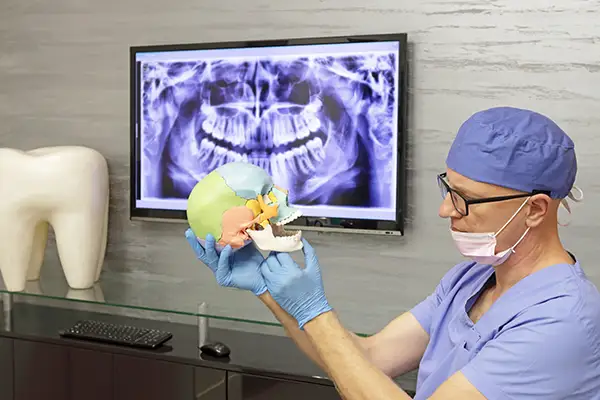 Your upper and lower teeth aren’t just supposed to touch – they’re supposed to touch in a specific, distributed way, with the load spread across multiple teeth at the same instant when you bite down. The technical term is occlusion, and it’s a more delicate system than most people realize.
When one or two teeth contact slightly ahead of the others, those teeth absorb a disproportionate share of every bite for years. Multiply that by the thousands of chewing cycles in a day and the involuntary clenches during sleep, and you have a recipe for accelerated wear, microscopic enamel cracks, sensitivity, and eventually tooth mobility or restoration failure.
The jaw joint and surrounding muscles compensate too. They adjust posture, recruit different muscle groups, and tense up to make the imbalance “work.” That compensation is usually what produces the symptoms patients actually notice.
Signs Your Bite May Be Off
Bite issues rarely announce themselves clearly. They show up sideways, in symptoms patients don’t always connect to their teeth.
Recurring jaw soreness or fatigue when chewing is one of the most common patterns. If your jaw feels worn out by the end of the day, or particular foods (a tough piece of meat, a bagel) leave the muscles around your jaw aching, the bite is often the cause. Closely related is the pattern of recurring headaches, especially tension headaches in the temples, behind the eyes, or at the base of the skull. These are commonly tied to bite imbalance and the clenching that develops around it.
Uneven tooth wear is the visible side of the same issue. If one side of your mouth has noticeably flatter, more worn-looking biting surfaces, sharp edges on certain teeth, or chipping that keeps happening in the same spots, those teeth are taking more force than they should.
Sensitivity that seems to move between teeth without an obvious cavity is often a hairline crack in a single overloaded tooth, or inflammation in the ligament around it. So is unexplained tooth mobility in a tooth surrounded by healthy gums. A tooth that wiggles slightly but has no gum issue is often being overloaded by an uneven bite force.
Clicking, popping, or grinding sounds in the jaw joint signal that the disc inside the joint isn’t tracking the way it should, which is frequently triggered or worsened by bite issues.
Two other signs are worth flagging because patients often notice them but don’t recognize them as bite-related. A new crown, filling, or other restoration that feels “high” when you bite means the restoration shifted the whole bite pattern, and your jaw will fight it for weeks before adapting (if it adapts at all). And teeth that feel different after orthodontic treatment, including aligner cases, often means a final refinement of the bite is needed.
Finally, if you find yourself chewing on one side because the other side feels uncomfortable, that’s a bite issue being routed around rather than solved.
Any one of these in isolation may not mean anything. Two or three together is usually a real signal.
What’s Causing the Imbalance
A bite goes off-balance for several reasons. The most common is restoration history. A filling, a dental crown, an onlay, or a bridge that wasn’t adjusted perfectly to the rest of your bite at placement will create a high spot that shifts how forces distribute. Sometimes the adjustment was correct at the appointment but settled differently as you adapted, which is part of why follow-up bite checks matter.
Wear over time is another. As enamel wears down on certain teeth, often the front teeth in patients who grind or clench, the back teeth start contacting earlier and harder, which compounds the wear pattern.
Tooth loss without replacement contributes. When a back tooth is missing for years, the teeth around it slowly drift, tip, or supererupt into the empty space, which changes the contact pattern across the whole arch.
Orthodontic treatment, including aligner cases that didn’t include a thorough final bite check, occasionally leaves small contact imbalances behind. The same is true of certain growth and development patterns that show up only in adulthood.
Finally, bruxism (grinding and clenching, often during sleep) both reveals and creates bite imbalances. The grinding wears the contact points unevenly, which then creates new high spots, which then trigger more compensatory grinding. Breaking that cycle is part of what a comprehensive bite plan addresses.
What a Bite Adjustment Involves
A bite adjustment isn’t a single thing. It’s a range of options chosen based on what’s actually causing the imbalance.
The first step is always evaluation. The dentist has you bite on articulating paper (the thin colored film) so the high contact points mark themselves on your teeth. From there, the contact pattern is mapped: where teeth touch first, where they should touch, what the muscles are doing while you bite, and how the jaw joint is responding.
If the imbalance is small – a recently placed restoration that sits a hair high, or a small enamel ridge developing into a high spot – the adjustment is straightforward. A fine polishing instrument removes a microscopically thin layer of enamel or restoration material from the marked contact, the bite is rechecked, and the process repeats until contacts are distributed properly. Most patients feel an immediate difference in how the teeth meet.
For more involved imbalances, the plan may include a TMJ treatment component, a custom night guard to relieve the muscle pattern while teeth and joints settle, and sometimes a coordinated approach to rebuilding worn teeth so the bite has a stable foundation to rest on.
In complex cases, imaging and a more comprehensive workup come first. A customized treatment plan makes sure the steps happen in the right order, since adjusting a single tooth in isolation when the underlying issue is broader can make things worse rather than better.
It’s worth noting that bite adjustment is conservative dentistry when done thoughtfully. The amount of enamel removed in a routine adjustment is tiny, usually less than what would be lost to a single year of unchecked grinding on the same tooth.
Taking the Next Step in Madison
If two or three of the signs above sound familiar, the most useful next step is a bite-focused evaluation, not waiting until the symptoms get worse. Our team at Singing River Dentistry checks bite patterns as part of routine exams at our Madison, AL office and can spend additional time on a full bite workup when patients are noticing changes. Call us at 256-653-9830 or visit our practice home page to schedule a visit.
Frequently Asked Questions
Does a bite adjustment hurt?
The adjustment itself is not uncomfortable. The dentist removes only a microscopic amount of enamel or restoration material from very specific spots, no anesthesia is needed, and most patients feel relief almost immediately as the high contact gets corrected.
How long does a bite adjustment appointment take?
A focused adjustment, such as smoothing a recent crown that sits a little high, is often done in twenty to thirty minutes. A full bite evaluation and adjustment for someone with multiple symptoms takes longer because of the diagnostic time involved.
Can a bite issue cause headaches?
Yes, this is one of the more common patterns we see. A bite imbalance often triggers compensatory clenching of the jaw muscles, and those muscles refer pain into the temples, behind the eyes, and along the side of the head, producing what feels like a tension headache.
Will I need a night guard after a bite adjustment?
Many patients do, especially if grinding or clenching was part of what created the imbalance. A custom night guard relieves the muscle pattern overnight and protects both teeth and restorations from the next round of wear while everything settles.
Is bite adjustment the same as TMJ treatment?
They overlap but aren’t identical. A bite adjustment is a specific corrective step within the broader category of jaw and joint care. Some patients only need the adjustment; others need it as one part of a wider TMJ-focused plan that may include therapy, a guard, and sometimes coordinated restoration. |
|

